
Knights buys Moore Barlow for £27m: what the back office tells you about the model

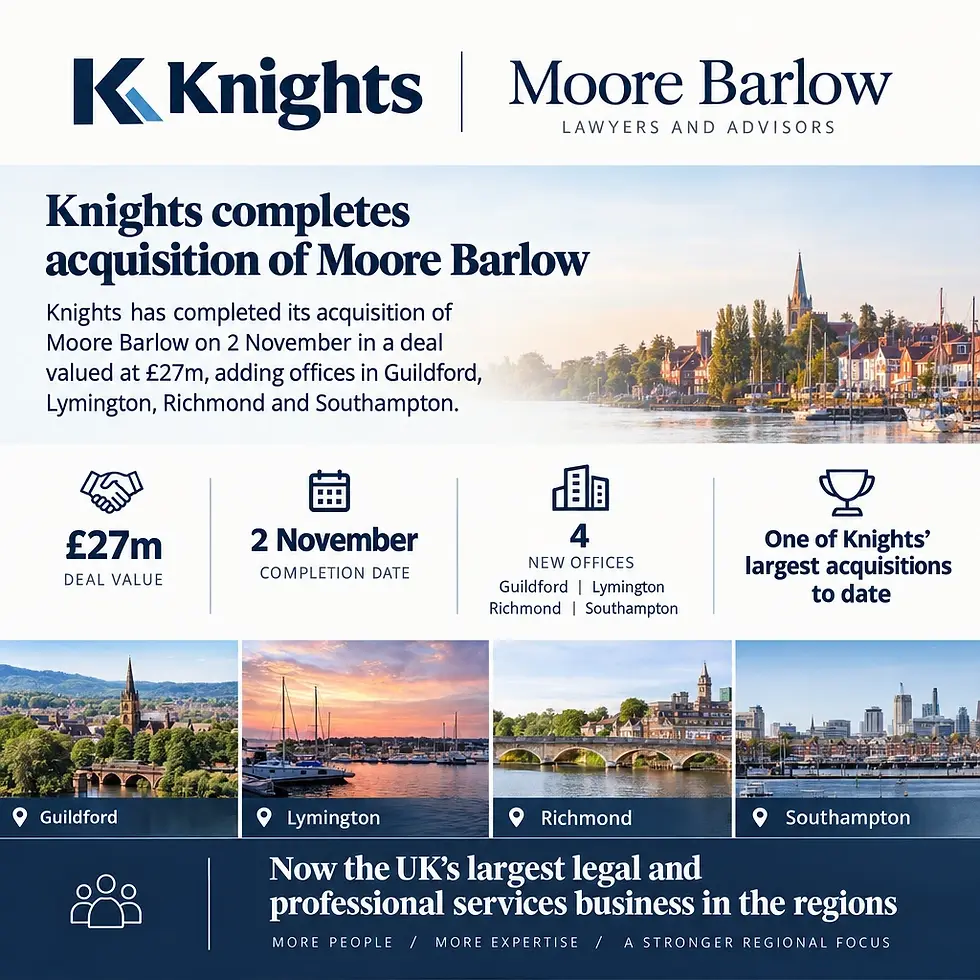
Knights completed its acquisition of Moore Barlow on 2 November in a deal valued at £27m, adding offices in Guildford, Lymington, Richmond and Southampton. It is one of Knights' largest acquisitions to date, and the firm says it now makes Knights the largest legal and professional services business in the UK regions.
The strategic case is set out cleanly. More than 200 professionals in commercial real estate, over 100 in residential property, and a large specialist group in landed estates and rural business. David Beech, Knights' chief executive, put it in terms of relationships: the strength of Moore Barlow "has always been its people", and professional services should be personal, with clients able to reach the people advising them.
Moore Barlow's own LinkedIn post, marking the end of a business that has existed in some form for 200 years, used the language of scale. Being part of Knights provides the capacity to invest in people, technology and expertise while retaining close client relationships.
The arithmetic
Moore Barlow's most recent accounts show 447 people employed during 2024/25. Around 160 fee-earners are being retained. The firm has declined to comment on the exact number of job losses, and former employees have been announcing their departures on social media, some after decades with the firm.
That gap is the deal. It is not a scandal, and it is not unique to Knights, which has followed this model consistently: keep the fee-earners and the client relationships, consolidate the premises, and remove most of the support function on the basis that one back office can serve a much larger business than the one it was built for.
The premises say the same thing. Woking and Guildford have been consolidated into a single new Guildford location, and the City base has closed.
The team moves are the detail worth watching. Moore Barlow's clinical negligence and personal injury teams join Fletchers Solicitors, and its Court of Protection team joins EMG Solicitors, part of Fletchers Group. Some of the acquired expertise is therefore not going to Knights at all. That may be sensible for the teams and their clients, and it makes the integration map harder rather than easier.
What "scale" is buying
It is worth being precise, because the word is doing a lot of work in both statements.
Scale in a professional services business does two different things. It spreads fixed costs, which is the back-office point, and it lets you resource work that a smaller firm could not take on. The first saves money. The second wins instructions. Both are legitimate reasons to buy a competitor, but they are not the same reason, and a firm that buys for the second while paying for the first is making a bet on integration.
I have written before about why keeping a firm small is a risk strategy rather than a lack of ambition, and about how debt-fuelled roll-ups have failed in this market. This deal is neither of those things on its face. It is a solvent acquirer buying a firm with a long history, and the consideration was paid.
The integration risk is almost never in the client-facing part. It is in the things that were nobody's job to notice: which engagement letters need reissuing under the acquiring entity, whether the fee arrangements still match what the client agreed, where the undertakings sit, how the complaints route is now described, and who holds the file when a matter straddles completion. Those questions do not appear in a press release. They are the ones that generate the complaints afterwards.
For clients of an acquired firm
Four things are worth confirming rather than assuming. Who is the solicitor on record for your matter, and has that changed. Which entity holds your retainer, and has a new one been issued. Whether the fee arrangement you agreed survives the transfer unchanged. And where a complaint now goes, including a complaint about something that happened before the transfer.
None of those are hostile questions. A firm managing the integration properly will have the answers ready.
For staff
The employment position follows the transaction, and the general principles are worth stating carefully, because the facts of an individual case decide the outcome. On a transfer of a business, the contracts of transferring employees generally move with it, and a dismissal by reason of the transfer is generally unfair unless it is for an economic, technical or organisational reason entailing changes in the workforce. Redundancy connected to a merger can be such a reason.
The process still has to be run properly: genuine consultation, fair selection, and the correct procedure for the numbers involved.
The harder truth is that in a deal of this shape the decision about the back office was taken long before the announcement. Staff told on day one that nothing will change should read that as reassurance about the clients, not about the payroll.
My view
I think the interesting number in this deal is not £27m. It is 447 down to roughly 160 fee-earners plus a management structure, against a promise that clients will still know the people advising them. Both things can be true. A single back office can release fee-earners to do more fee-earning, and a client can still have a named solicitor who answers the phone.
What decides whether it works is not the model. It is whether anyone owns the unglamorous list: the letters, the retainers, the undertakings, the complaints route, the file at completion. Most post-merger complaints I see are not about the advice. They are about a document that was never reissued, and a client who found out about the change from a letterhead.
Twenty-seven million pounds for four offices, 160 fee-earners and two centuries of name. The part not in the price is everyone else who made the name work.
If you would like an independent view of where your firm stands on compliance, I offer a complimentary health check, with no obligation. Get in touch and we can arrange a time to talk it through.
The contact page is an enquiry form, so please put "free health check" in the message subject and I will pick it up straight away.
Ashley Barwick, Fraxinus Business Associates. This post is general information and does not constitute legal advice. Fraxinus Business Associates is not authorised to provide legal advice.
Sources
Law Society Gazette, "Support staff face axe as £27m merger deal completes", John Hyde, 3 November 2026. https://www.lawgazette.co.uk/news/support-staff-face-axe-as-27m-merger-deal-completes/5128409.article
Further reading on this blog: "The Myth of Scaling: Why Keeping Your Law Firm Small Is the Ultimate Power Move"; "From boom to bust: How private equity roll-ups fractured legal practice and overwhelmed the SRA".


Comments