
The FCA takeover of AML supervision reaches the Commons: what the Law Society's warning means for a small firm

The Law Society has called on the government to make sure the new anti-money laundering reforms do not leave law firms facing overlapping regulation, unnecessary financial burden and conflicting requirements. The Financial Services and Markets Bill, which enables the change, had its second reading in the House of Commons today.
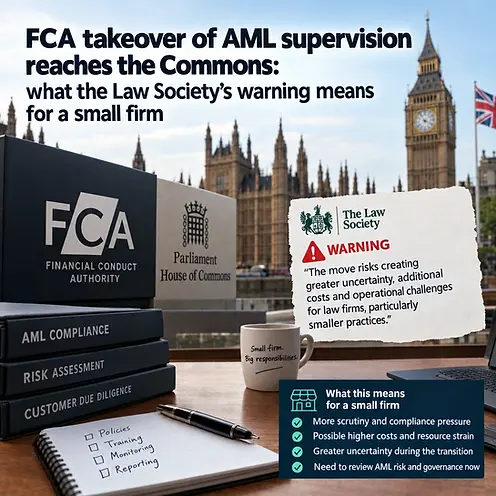
The FCA is due to take over policing of the money laundering regulations from the Solicitors Regulation Authority and from the other legal and accountancy regulators by the end of 2028. I wrote about the substance of that transfer in October, when the FCA set out its approach at the Law Society Economic Crime Conference. What is new today is the legislative timetable and the Society's intervention in it.
Society president Brett Dixon described the reforms as "a seismic change to law firms and the legal sector", and confirmed support for robust action against economic crime. The concern is what travels with it: duplication, cost, and requirements that pull in different directions.
He asked for clarity on how responsibility will be divided where more than one regulator has an interest in the same issue, and for proper assessment of the effect on firm owners, managers and money laundering reporting officers, "whose businesses and positions risk being the most affected by the changes".
That is a fair list. It is also, in substance, a list of things that will be settled in secondary legislation and supervisory practice over the next two years, most of which no individual firm can influence.
Where the duplication actually bites
The general worry is two regulators and two sets of rules. The reality is usually subtler.
Regulators converge on the same underlying obligations, because the obligations come from the same directives. What diverges is everything around them: how quickly a suspicious activity report should be filed, what supporting material should sit behind it, and what counts as adequate customer due diligence for a client of that type. Two supervisors can give two answers, and the firm in the middle holds a file that will be examined against whichever standard applies on the day.
The other issue is calibration. The FCA supervises large, systems-driven businesses. A four-partner high street firm with a conveyancing-heavy caseload is not that, and its compliance function is one person with other fee-earning work. If the supervisory expectation is set for the population the FCA knows best, small firms will find themselves arguing that their controls are proportionate rather than absent. That argument is winnable, but it needs evidence, and the evidence is the risk assessment and the policies underneath it.
The MLRO point is the one to take seriously
Dixon's reference to MLROs is the sharpest part of the Society's statement, and it deserves more attention than it will get.
The MLRO is personally exposed in a way the other controlled functions are not. A report that is not made, or made late, or made without the internal report that should have preceded it, is a decision attributed to a named individual. Move supervision to a regulator with a different enforcement culture and a different view of personal accountability, and that exposure changes even though the firm's obligations have not changed at all.
In a small firm, that person is often a partner carrying a full caseload, with no dedicated compliance staff and no budget for any. That is the position the reforms land on hardest, and it is the position the Society was right to name.
What to do before 2028
Two years is simultaneously a long time and not very long. Four things are worth doing while the detail is still being written.
First, map which obligation comes from where. Which requirements come from the SRA handbook, which from the money laundering regulations, and which will follow the FCA. If that map exists now, dual supervision is an administrative inconvenience. If it does not, it becomes a series of surprises.
Second, read your business-wide risk assessment as though you had never seen it. Is it written for your clients and the work you actually do, and is it dated and reviewed? That document is the first thing any supervisor asks for, and the one most often written once and never revisited.
Third, test the reporting line rather than assuming it. A firm should be able to say without looking it up who makes a report, who covers for them, how a fee earner raises a concern, and what the record looks like afterwards. Three or four files will tell you whether that works or whether it exists only in the policy. I set out a short version of that check in the ten-day test.
Fourth, put the FCA's fees in the budget conversation. Supervision will be funded on a full cost-recovery basis, and the fee consultation has not produced a figure. No figure exists, so do not invent one. Just make sure the question is in your 2027 and 2028 planning before it arrives as a surprise.
My view
The Society is right about duplication, and I would add one thing to its statement. The compliance record a firm builds between now and 2028 is the record it will be judged on afterwards. Regulation 58 assessments already reach integrity, competence and compliance history, not just convictions. Nobody has said how the FCA will weigh past SRA findings, so I will not guess. But a clean, documented history has never been a disadvantage.
The Bill will be amended. The transition may move. The detail will be argued over by people with more influence than any small firm has. The work that protects a firm in 2028 is the work that is available now.
If you would like an independent view of where your firm stands on compliance, I offer a complimentary health check, with no obligation. Get in touch and we can arrange a time to talk it through.
The contact page is an enquiry form, so please put "free health check" in the message subject and I will pick it up straight away.
Ashley Barwick, Fraxinus Business Associates. This post is general information and does not constitute legal advice. Fraxinus Business Associates is not authorised to provide legal advice.
Sources
Law Society Gazette, "Society warns of AML regulatory clash", Gazette reporter, 10 November 2026. https://www.lawgazette.co.uk/news/society-warns-of-aml-regulatory-clash/5128483.article
Law Society Gazette, "City watchdog seeks 'partnership' with solicitors on AML", 2026. https://www.lawgazette.co.uk/news/city-watchdog-seeks-partnership-with-solicitors-on-aml/5127935.article
Law Society Gazette, "Firms warned against complacency ahead of FCA takeover", 2026. https://www.lawgazette.co.uk/news/aml-firms-warned-against-complacency-ahead-of-fca-takeover/5126180.article
Further reading on this blog: "The FCA is taking over AML supervision of law firms: what a small firm should do now" (21 October 2026); "The ten-day AML test: could your firm hand over its paperwork if the SRA asked tomorrow?"; "The SRA's AML report: better compliance, but the same weak spot on source of funds".



Comments